Future of Cancer Diagnostic
Why Earlier Detection Matters
Annually in October there is the renewed attention on Breast Cancer Awareness month, which is one of the world’s most significant healthcare challenges, especially in Middle- and Low-income countries (M/LIC).
Latest estimates from the World Health Organisation (WHO) indicate that approximately 2.4 million women were diagnosed with breast cancer in 2024 with around 694,000 deaths worldwide. Unfortunately, it remains one of the most commonly diagnosed cancer among women globally.
Behind each data point are patients and their families with healthcare systems and tools confronting a disease in which timing can matter enormously.
WHO has maintained that identifying early detection and timely diagnosis which is linked to a comprehensive treatment plan are fundamental components of reducing this burden.
But as diagnostic platform technologies continue to advance, there is another question worth asking:
Is detecting disease earlier enough?
At DCN Corp® we believe that the next challenge extends beyond detection alone.
The future lies in the ability to smartly combine earlier detection with greater diagnostic confidence.
Earlier Detection can change the Diagnostic Pathway
Unfortunately, cancer develops over time.
In breast cancer and the associated abnormal cells can initially remain localised and unseen by most of the existing techniques before the invasive disease progresses to the surrounding tissue and, in some cases, spreads to lymph nodes or distant organs.
The ability to detect breast cancer before it has progressed can create greater opportunities for earlier and effective treatment programmes. WHO itself states that breast cancer mortality and mobility is reduced when patients are detected and treated early.
This principle requirement underpins two related but markedly different approaches:
For example, in the UK the National Health Service (NHS) routinely does breast screening by using mammography/mammograms to identify cancer cells that may be too small to see or feel.
The scientific and engineering challenge therefore extends beyond simply developing (platform) technologies capable of identifying minute biological signals.
Consequently, those signals must provide reliable data/information upon which healthcare decisions can be based.
Trace-level Detections to Diagnostic Confidence
The capability to detect minute concentrations of a target analyte and/or bio-marker can represent an important bio-analytical achievement. But as articulated in DCN Corp® LinkedIn articles bio-analytical sensitivity alone does not make a diagnostic technology clinically useful.
A prospective diagnostic platform technology may need to answer several questions simultaneously:
From the questions above the concept of diagnostic confidence becomes important.
A lower Limit of Detection (LoD) may demonstrate impressive bio-analytical sensitivity.
But the future of healthcare requires more than the smallest possible number appearing on a screen.
It requires data/information that can be trusted.
Breast Cancer is not a Singular Biological signal
One factor why this challenge matters is the biological complexity of cancer.
Unfortunately, breast cancer is not a singular uniform disease.
Clinical assessment can traditionally involve imaging, tissue sampling, pathology and bio-molecular characterisations. Whilst treatment pathways depend on multiple factors like cancer sub-type and the extent to which disease has already spread.
This therefore illustrates an important principle for next-gen diagnostics:
Biology rarely provides a one-for-all perfectly isolated signal mode
Real biological samples can contain complexities such as proteins, cells, metabolites and numerous other bio-molecular components.
The challenge is therefore not merely detecting something. It is the ability to identify the right biological data and/or information within a complex environment.
For emerging bio-sensing platform technologies, this can place considerable importance on bio-analytical selectivity, nano-scale surface chemistry, bio-sensor architecture, sample preparation and the final signal interpretation on a screen or a spectrogram.
Could Bio-markers help us see Diseases Earlier
Bio-markers when smartly employed offer the possibility of obtaining data/information about biological processes through easily measurable bio-molecular characteristics.
As specialist and laymen knowledge increases in cancer biology, combinations of bio-markers may contribute to areas including disease detection, characterisation, monitoring and treatment selections. This dynamism creates an important opportunity for diagnostic innovation.
Instead, of relying exclusively on a singular measurement modality, future healthcare systems and tools could integrate data/information from:
Imaging + Biomolecular Diagnostics + Pathology + Clinical data/information
The overall objective should not be to replace established diagnostic pathways simply because a new technology or technique exists. Rather, a new invention or innovation should be asking:
Where can additional high quality data/information improve the existing pathway?
Understanding this distinction is crucial
Nanotechnology & Future of Bio-sensing
As previously articulated at the nano-scale materials can exhibit unique optical, electrical and chemical properties that differ markedly from their bulkier counter-parts. These unique set of properties create opportunities for highly sensitive bio-sensing.
Metallic nano-structures called nanoparticles (NP), especially those synthesised from noble metals of Group 11 of the Periodic table, interact smartly and strongly with electromagnetic radiation and produce surface/non-surface phenomena that can be exploited for trace level bio-molecular detections.
Technologies of particular interest include:
Collectively the technologies above illustrate how Nanotechnology can potentially amplify our ability to interrogate existing biological systems. But amplification creates another science and engineering challenge, which is that a stronger signal is only valuable if it remains reliable.
From Lab to the End-user & Patient
Many emerging diagnostic platform technologies and techniques laboratory-wise demonstrate impressive performance metrics when carefully controlled.
But real healthcare environments are different, and clinical samples are complex. This is because temperature and storage conditions may vary. Manufacturing introduces tolerances. Instrumentation may differ from one laboratory to another one. Point-of-Care (PoC) and/or Over-the-Counter (OtC) environments may have fewer controls than centralised laboratories.
The transition from Proof-of-Concept (PoC1) research to healthcare application, therefore, requires progressively answering a much harder question:
Can the technology maintain meaningful performance metrics outside the conditions in which it was originally developed?
This is where bio-analytical validation, clinical validation, quality management systems and tools, manufacturing controls and regulatory evidence become essential phases.
Point-of-Care & Over-the-Counter Platform Diagnostic
Bringing Info Closer to the Final Decision
Another important objective in diagnostics is the movement of testing closer to the end-user and patient.
PoC and/or OtC platform technologies have the potential to reduce the distance between:
Sample → Testing regime → Result → Final decision
Principally shorter diagnostic pathways could support faster access to useful data/information, especially where conventional laboratory infrastructure is constrained.
But de-centralisation requirements also creates new engineering requirements. Consequently, a PoC and/or OtC platform technology may need to operate with:
The closer diagnostic technologies move towards the patient and their families, the more important robustness, usability, actionability and reproducibility become.
Plus speed without accuracy provides little benefit. Bio-sensitivity without specificity may create uncertainty. Accessibility without reliability does not solve the diagnostic challenge. Therefore, the objective must be to combine all of them.
Earlier Detection should enable Timely Diagnosis
The technological capability to detect a condition and/or disease earlier does not automatically improve patient outcomes. The data/information must connect to an effective healthcare pathway.
That is why WHO’s Global Breast Cancer Initiative is build around three complementary pillars:
Health promotion for early detection → Timely diagnosis → Comprehensive breast cancer management systems and tools
The initiative’s objectives is to include at least 60% of invasive breast cancers diagnosed at Stage I or II by completing diagnostic evaluation within 60 days of initial presentation, and ensuring 80% of patients complete indicated multi-modality treatment programmes.
This distinction is particularly important for diagnostic innovators. A diagnostic result only becomes meaningful when it can contribute to an appropriate clinical decision and, where necessary, timely access to treatment.
Accessibility Matters
Unfortunately, global breast cancer mortality is not distributed equally.
WHO reports substantial differences in breast cancer outcomes between countries and regions at different levels of development. In fact, its latest global survival analysis also highlights major regional and income disparities with approximately 70% of estimated breast cancer deaths in 2024 occurring in L/MICs.
A technically sophisticated diagnostic platform technology has limited global impact if it requires infrastructure, expertise and/or costs that make widespread deployment impractical. Therefore, future diagnostic development cycles should not consider bio-analytical performance metrics, but also:
Cost | Scalability | Portability | Ease of use | Mass manufacturability | Infrastructure | Accessibility
Innovation chances of success increase when technological capability and real-world accessibility develop together.
Earlier Detection to Diagnostic Confidence
Breast Cancer Awareness Month is rightfully an opportunity to encourage awareness, mass screening participation where appropriate to do so, timely medical evaluation and empathetic support for those affected by breast cancer.
Furthermore, it should encourage us to think about what the next-gen of diagnostic technology must achieve. This ambition should extend beyond detecting minute concentrations of biological/chemical material.
We need technological developmental programmes capable of transforming complex biological signals into accurate, reproducible and clinically meaningful data/information.
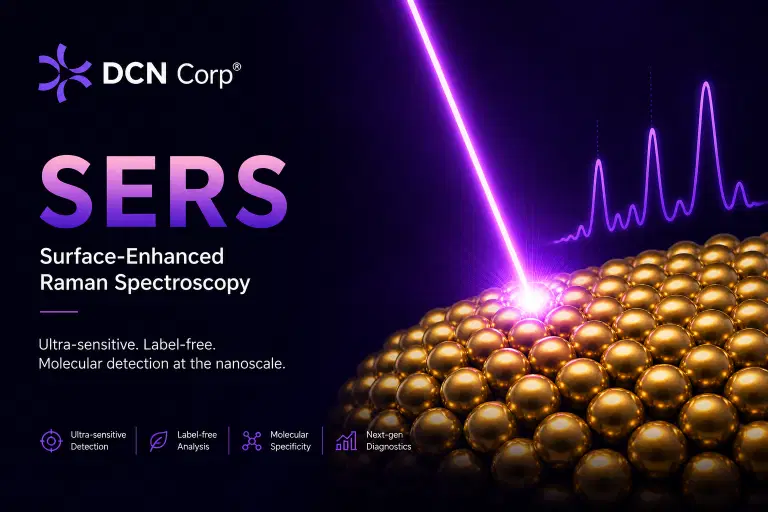
At DCN Corp® our work continues to explore the inter-section of Nanotechnology, plasmonics and bio-sensing including surface technologies such as SPR, LSPR, SERS and Raman spectroscopy. That is why our long-term objective is not sensitivity for sensitivity’s sake.
It is the engineering challenge of smartly translating advanced detection science towards reliable, reproducible and easily accessible diagnostic platform technologies.
The future of diagnostics will not be defined simply by whether we can detect something earlier. It will be defined by whether we can trust what we detect and use that data/information to make better decisions.
Looking Ahead
The future of cancer diagnostics is unlikely to depend upon one technology solely.
Imaging, pathology, bio-molecular diagnostics, bio-sensing and emerging bio-analytical technologies may provide complementary layers of data/information. Therefore, there is a real opportunity to make that data/information earlier, increased accuracy, accessibility and actionability.
For breast cancer and healthcare broadly the objective remains unchanged:
Earlier Detection > Greater Confidence > Better Decisions
Please note this blog has been published in support of the Breast Cancer Awareness Month, and it is intended for educational and informational purposes only and does not constitute medical opinion nor advice. Emerging platform diagnostic and Nanotechnology approaches discussed in this blog may remain at research and development stages, and should not be interpreted as direct replacements for established breast cancer screening, diagnostic or clinical care pathways.